Decapitalism
We need to talk about capitalism in art education because we need to talk about capitalism in art – and everywhere beyond. This course is an attempt to create a clearing where we can feel, think, and work through the challenges ahead together.
Since 2020 I have been teaching the course Postcapitalism at the MA Creative Producing of the Academy of Theatre and Dance in Amsterdam. I am not gonna lie – I have been joking we should rename it Anticapitalism, but in line with its sister course Decolonisation, maybe the right move is Decapitalism.
The course is structured in three classes:
- What do we talk about when we talk about capitalism? On the history of capitalism, its manifestation in the Netherlands, and fascism as the final boss.
- There are alternatives. On the history of free association, cooperation and mutual aid across the world, past, present and future.
- Degrowth as creative praxis. On the climate emergency, degrowth communism, and the reimagining of creative production.
The goal of the course is for students to study the origins, manifestations, and consequences of ideological choices made by a specific group of people – and how almost everything on earth is mobilised in order to maintain their hegemony.
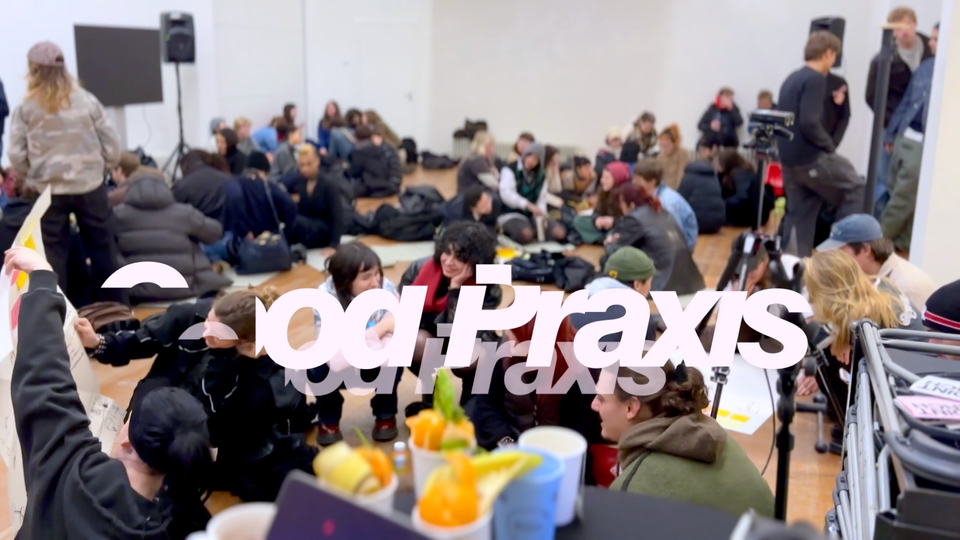
Each class begins in a circle. We check in and share how we enter the room. As I am a feelings-first teacher, instead of giving students a reading list, a syllabus and homework to prepare for the course, we watch videos together for the first hour (of three). The students then discuss what they've seen in smaller groups to express their feelings, and put words to the concepts in their own terms.
Some of the videos we watch are from TikTok, where young people lament the polycrisis and long for the end of capitalism. Others are from YouTube: documentaries on the Zapatistas, Rojava, and Cooperation Jackson. From these longer videos I usually edit sections of 5-10 minutes at a time, the parts most moving or most convincing, so we get to actually sit with a subject and be enveloped by its history – with enough examples from around the world to avoid eurocentrism.
After a short break, we return with an exercise that combines feeling and writing – two forms of thinking that complement each other. This could be mapping wants, haves, and needs, designing mutual aid projects, or building a spectrum of individual and collective plenitude and scarcity. These exercises make abstract concepts – dominion, mutuality, degrowth – concrete in our private and professional lives. They are co-operative acts, requiring students to walk around, discuss, and decide together. Each exercise is rounded off with a collective reflection, followed by a second break.
Each class ends where it begins: in a circle where we check out. We talk about our feelings after, how we leave the room, and we try to connect the course subject matter to the material conditions of our own creative practices.
Some of the books on the voluntary post-class reading list are:
- What do we talk about when we talk about capitalism?
• Henriette Roland Holst, Kapitaal en Arbeid in Nederland (1902)
• Anton de Kom, Wij slaven van Suriname (1934)
• Aimé Césaire, Discourse on Colonialism (1950)
• Frantz Fanon, The Wretched of the Earth (1961)
• Eduardo Galeano, Open Veins of Latin America (1971)
• Walter Rodney, How Europe Underdeveloped Africa (1972)
• Édouard Glissant, Poetics of Relation (1990)
• Silvia Federici, Caliban and the Witch (2004)
• China Miéville, The City & The City (2009)
• Gloria Wekker, White Innocence: Paradoxes of Colonialism and Race (2016) - There are alternatives.
• Ursula K. Le Guin, The Dispossessed: An Ambiguous Utopia (1974)
• Subcomandante Marcos, Our Word Is Our Weapon (2001)
• Fiona Buckland, Impossible Dance: Club Culture and Queer World-Making (2002)
• carla bergman & Nick Montgomery, Joyful Militancy: Building Thriving Resistance in Toxic Times (2017)
• Leanne Betasamosake Simpson, As We Have Always Done (2017)
• Kali Akuno & Ajamu Nangwaya (eds.), Jackson Rising (2017)
• Dean Spade, Mutual Aid (2020)
• adrienne maree brown, We Will Not Cancel Us: And Other Dreams of Transformative Justice (2020)
• Mariame Kaba, We Do This 'Til We Free Us (2021)
• Dilar Dirik, The Kurdish Women's Movement (2022) - Degrowth as creative praxis.
• Anna Kavan, Ice (1967)
• Ivan Illich, Tools for Conviviality (1973)
• Amitav Ghosh, The Great Derangement: Climate Change and the Unthinkable (2016)
• Kathryn Yusoff, A Billion Black Anthropocenes or None (2018)
• Ulrich Brand & Markus Wissen, The Imperial Mode of Living (2021)
• Isabelle Fremeaux & Jay Jordan, We Are 'Nature' Defending Itself (2021)
• Max Liboiron, Pollution Is Colonialism (2021)
• Kohei Saito, Slow Down: The Degrowth Manifesto (2024)
• Alexander Dunlap, Can Degrowth Struggle? Anarchist Engagements with Degrowth (2025)
• Lars Holdhus & Arnau Sala Saez, Resistance for Artists (2026)
We need to talk about capitalism in art education because we need to talk about capitalism in art – and everywhere beyond. This course is an attempt to create a clearing where we can feel, think, and work through the challenges ahead.
As Dean Spade says it: we're all we got, and we're all we need.